Poverty
Der goldene HandschuhPoverty in the novel is a lived environment as much as an economic condition: it dictates where people can sleep, what they can eat, how they endure the cold, and how little control they retain over their own lives. Gerda’s homelessness and dependence on Fiete Honka bring those pressures into close focus, while the ruined streets and crowded, damp housing around them make deprivation part of the urban landscape. The novel sets this world beside the wealth of a Hamburg shipping dynasty, but suggests that money does not guarantee humanity; its sharpest contrast is between unequal resources and the shared, often frustrated desire for happiness.
Poverty as a Social Landscape
The novel locates poverty in a world of abandoned or deteriorating housing, precarious work, hunger, cold, and alcohol. Its setting is the night-time world of bars, rundown quarters, and people pushed to the margins, where even the victims are known to the authorities and exposed to public scrutiny. Poverty is not presented as a single misfortune that can be separated from everything else. It gathers force through ordinary necessities—warmth, food, a place to live—and through the scarcity that leaves people with few safe choices.
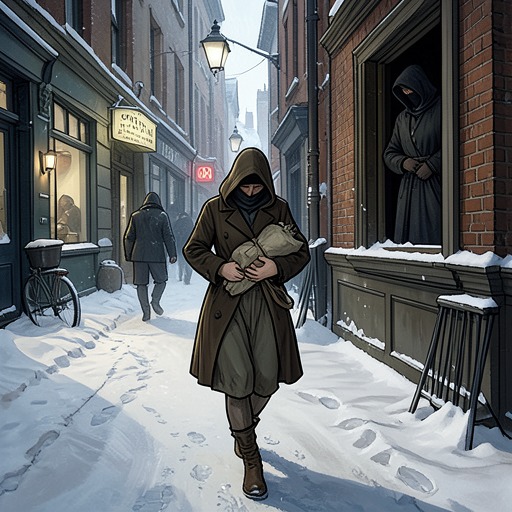
The streets make that accumulation visible. On the way to Fiete Honka’s home, Gerda and Fiete pass broken motorcycles and bicycles, damaged lines, peeling walls, shattered windows, rusting signs, and crumbling, unfinished masonry. The surroundings seem damaged at every scale, from the street to the buildings. This is not simply a backdrop to their private hardship: the walk through the city gives deprivation a physical continuity, leading from exposure outdoors to the conditions inside the apartment.
Shelter, Hunger, and Daily Exposure
Gerda enters Fiete’s life without a fixed home and without money to buy herself a drink. At the bar, Fiete arranges for Anus to bring her one. The gesture is also a tactic: women told who has paid for their drinks come over to thank him. For Gerda, however, the immediate stakes are stark. If she does not drink, she must leave, and the temperature outside is below freezing. Her need for shelter and warmth makes even this small transaction consequential.
The walk back to Fiete’s apartment shows how poverty taxes the body. Gerda carries her own bag because Fiete does not think to take it from her. She repeatedly shifts the weight between her arms; her lips are dry, and she has no remaining tune to whistle. In the fine rain she becomes soaked, lies down twice, and struggles to continue. Fiete worries that he may not be able to help her back to her feet. Their journey takes them through the pale morning light to the attic apartment at Zeißstraße 74, a cramped home reached on the third floor.
The apartment measures only eighteen square metres and contains two rooms separated by a kitchenette. Its furnishings and accumulated objects offer no comfort against its condition: a rusted stove, damaged furniture, dirty clothes, a partly collapsed dresser, and a mattress split open. The kitchen floor is crowded with large bottles and smaller ones. Seven cans of air freshener and five packets of air cleaner sit alongside the smell of damp, rotting carpet, stale urine, dirt, and dead animals. Pin-up pictures cover the walls; dolls and stuffed animals share the living room with mismatched furniture. The layered disorder makes clear that the problem is not a single mess awaiting an easy remedy: the dirt has settled so deeply that the apartment seems to produce it anew.
Gerda’s Hope of Security
Gerda’s expectations have been reduced to surviving one more stretch of pain, fear, cold, and hardship. Memory offers a refuge, though not necessarily a reliable record of an easier life: in recollection, the sun grows brighter, colours more vivid, food more filling, and people more loving. She reasons that people who have known no happiness may have to imagine something beautiful until it becomes part of memory. Against the repeated sequence of poverty, hunger, cold, and war that has marked her life, this act of remembering gives her a way to endure what would otherwise feel unbearable.
Her hopes for the future are correspondingly modest and specific. She wants to live long enough for the state to have to provide a home and a small pension. Warmth, sufficient food, a bed, a wardrobe, a table, and a chair would be enough. She contrasts that desired security with the wealthy, who are not accustomed to having things taken from them, and imagines that the poor make small steps towards themselves while the rich lose their way. This is a hope, not a security she has already obtained. She has endured much, but must still imagine that enough strength and luck will carry her to a life in which the most basic needs are met.
Unequal Resources and the Novel’s Perspective
The novel also places this deprivation beside the money and business concerns of a Hamburg shipping family. That movement between the social margins and the upper levels of society widens the meaning of poverty: it is not an isolated misfortune but part of a divided world, where people have radically unequal access to shelter, resources, and choice. Yet wealth does not automatically bring humanity. The novel’s closing vision brings rich and poor together in an all-night bar amid alcohol, sex, misery, and crime, holding their different circumstances in view without denying their common longing for happiness.
Fiete Honka’s deteriorating circumstances form another part of this picture, though hardship does not erase his responsibility for what he does. After his hopes fail and Helga rejects him, he drinks heavily; on some shifts he consumes a whole bottle of grain spirit, and he can become too drunk to reach the bar afterward. His wages go on alcohol and prostitutes, while eating feels like a nuisance and everything else loses importance. The novel links material and emotional collapse to his worsening life, but does not make poverty an excuse for his violence. Its compassion for a world of scarcity and its attention to the people trapped within it coexist with a clear account of harm. Poverty shapes the limits and pressures of the characters’ lives; it does not make all their actions equivalent.